Comments from Recent Visitors

"Madeleine is refreshingly quirky and that is a wonderful quality. That is in addition to her extraordinary wealth of knowledge and openness."

"Madeleine gave us an objective view of the people and places we see on the news."

"Madeleine kept our children, 10, 13, 15 yrs interested and engaged (as only a former teacher can), and her depth of knowledge was welcome by the adults in the group."

"Madeleine gracefully navigated complex issues of faith and culture and we came away with a much better perspective of Jerusalem through 3,000 years of history"

"Madeleine has a talent for listening to what we're interested in and crafting an itinerary that when experienced, flows perfectly while she is open to being flexible and the serendipity of discovery"

"Madeleine was incredible - a huge wealth of information,

"We were a diverse group - different ages, religions, athletic abilities - and Madeleine managed to accommodate us all."

Madeleine was extremely professional with a wonderful sense of humour"


Monday, September 26, 2016

Rosh Hashanah: New Year, New Fruits

Summer is coming to an end. Jerusalem nights are cooler and days grow shorter. The end of the summer is also a harbinger of the new fruits which signify the change of season and start of a new year.

In another week - October 2nd - Jews around the world will celebrate Rosh Hashanah, the Jewish New Year 5777, with a festive family meal. The pomegranate will make an appearance on the table along with apples and honey and other traditional foods as we bless a sweet and fruitful new year.
Black Pomegranates last week

Olive trees are are also weighed down with fruit which will be harvested in another month when the country celebrates its olive festivals. Ripe pomegranates are hanging on the trees and fresh juice is being sold all around the old city
Red Pomegranates in Yemin Moshe Last week
Although the pomegranate is an ancient symbol steeped in tradition, it has re-emerged in contemporary culture, not only because of its beauty and rich history, but because the pomegranate is desirable for its healthy, antioxidant qualities. The word pomegranate, "rimon" or granade in Hebrew, is derived from the Latin words "pomum" (apple) and "granatus" (seeded). Grown in the Mediterranean region for several thousand years, this remarkable fruit is rich in symbolism and there are specific references to the pomegranate in the Bible. Together with the olive, grape, fig, date, wheat and barley, it is one of the 7 species of the Land of Israel mentioned in Deuteronomy 8-8.

Exodus 28:33-34 states that images of pomegranates be woven into the hem of the robe worn by the High Priest in the Temple. Pomegranates can also be found in the Bible in I Kings 7:13-22, where the fruit is depicted on the capitals of the two pillars which stood in front of the temple.

Image result for ivory pomegranate
First Temple (?)Ivory Pomegranate Israel Museum
In Christianity paintings of the Madonna and Child prominently display the fruit - a symbol of the resurrection and the hope of eternal life. Ancient Egyptians were buried with pomegranates in hope of rebirth.

Pomegranates in Islam are a symbol of harvest, wealth and wellness. The writings of the Quran refer to the fruit in three different instances and each time giving the sense that it's talking about a great harvest, land of plenty and being good stewards of what has been provided.

Whatever you believe, one thing is certain, olives and pomegranates are important part of the landscape of this land and I, for one, am very happy.



Thursday, May 19, 2016

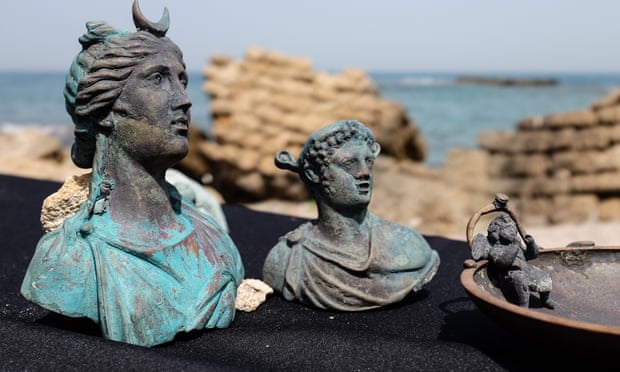
Amazing Underwater Archeological Discovery in Caesarea

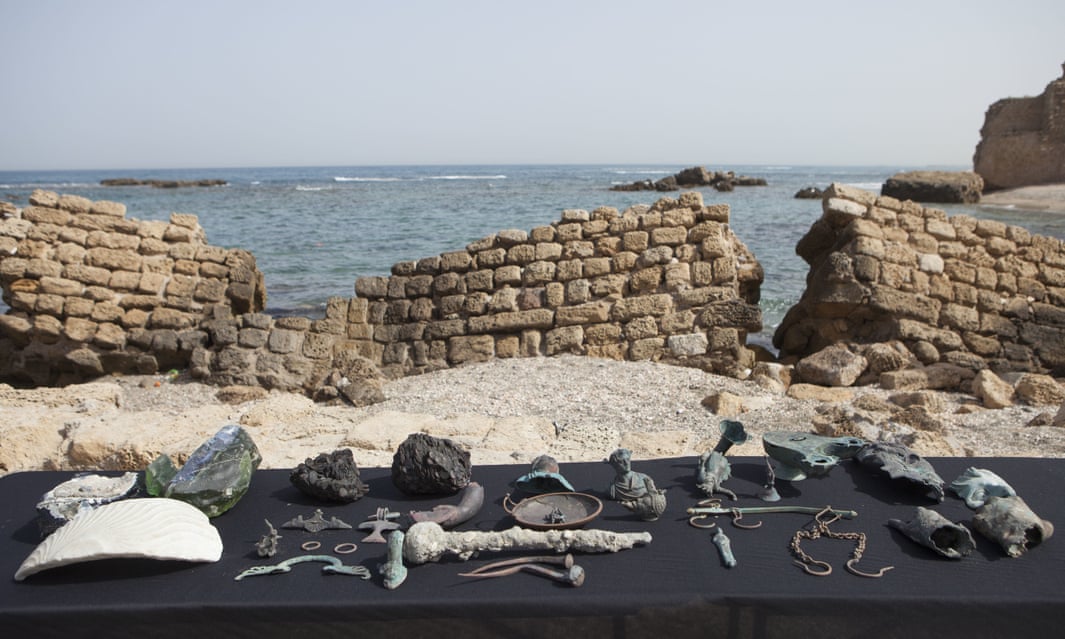
Two amateur divers discovered Israel’s biggest haul of underwater Roman-era artefacts in three decades. The priceless objects were shown for the first time last week.
Figurines of the moon goddess Luna and Dionysus, the god of wine.

The treasures were found in April by Ran Feinstein and Ofer Raanan when they were exploring a sunken ship close to the ancient port of Caesarea.
They initially left the first sculpture on the seabed, but then when they discovered a second, they realised it was something special and brought it to the surface. They later searched the area and uncovered more.
To their credit, they informed the Israel Antiquities Authority (IAA) who sent their divers to investigate further.
Some of the objects date back to the fourth century CE, while others are from the first and second centuries, said Jacob Sharvit, the director of marine archaeology at the IAA.
Sharvit said it was likely that the ship’s sailors had thrown down their anchors in a storm but, after their attempts failed, the ship drifted and all its cargo plunged into the Caesarea port waters, where it remained for 1,700 years until its recent discovery.

Hopefully the finds will be on public display very soon.  A recent treasure trove of 11th century Islamic coins found off the coast of Caesarea are currently displayed in the Israel Museum's archeology department.
On Display - some of the haul


Sunday, March 13, 2016

Mahane Yehuda - not just fruit and vegetables

Mahane Yehuda, also referred to as the "shuk" - the market - (not to be confused with the Arab souk in the old city), is one of my favourite places to visit in Jerusalem. Last Thursday night I decided to check out the beer and sample some of the night life of this iconic place.
The Largest Garlic Cloves I've Seen!
Mahane Yehuda is not actually the market, rather a small neighbourhood established across the Jaffa Road named for Yehuda Navon the brother of one of the neighbourhood's founders.
The Light Rail Stop
The market wasn't planned but grew organically from its humble beginnings at the end of the 19th century when local Arab farmers sold their produce to passengers disembarking from the carriage on its final leg from the Jaffa Port to Jaffa Gate.
Freshly Ground Tehina from Halva King
As the new city began to develop along the Jaffa Road, the area became more populous. By the 1920's the British decided to organise the random stalls on its current permanent site.
Olives - my favourite!
New Jewish immigrants opened stalls and to this day areas are known by the origin of its founders - the Iraqi Market and Georgian Market to name just two.
Dried Fruit and Nuts
Ramshackled structures have undergone renewal and, since the 1980's, the market has been gradually upgraded. Now you can find not only the freshest fruit and vegetables in town but also boutique clothing, wines and cheese and fun places to eat.
Challot for Shabbat
Beer Bazaar - local beers and friendly people
Not Just Beer
The shuk is transformed on Thursday nights after the stalls close. Tables are set out along the market streets and the young at heart enjoy food and beer into the wee hours.


All in all a wonderful cultural and gastronomic experience not to be missed. Make sure it's on your itinerary!

Monday, December 21, 2015

Merry Christmas and a Happy New Year

Beautiful blue skies and bright sunshine greeted us as we entered the Old City this morning. As we emerged from the Jaffa Gate we spied Santa Claus distributing free Jerusalem pine tree cuttings to the city's Christian population as part of a Jerusalem Municipal service.

As he rang his bell, people gathered around collecting their Christmas trees and taking pictures. For the first day of winter and shortest day of the year it was simply a perfect day.

 Santa inside Jaffa Gate
 Come and get your tree!
 
I wish everyone a happy and peaceful holiday and a new year filled with light and joy
 

 Candles at the Holy Sepulchre


Friday, November 13, 2015

Just Another Day at Work

I love Jerusalem. I have lived in this city for over 32 years experiencing the events that influence our daily lives.  Times of joy and hope; times of despair and frustration. In the past few weeks I have spent many hours touring the Old City and am pleased to see tourist groups out and about enjoying the sites.

As I walked around I decided to photograph some holy sites from different perspectives. I met with Christians, Muslims and Jews who are struggling to make a living and hoping for a better future for their families. I am sharing with you the results of my week of touring

Light through a window - Church of All Nations, Gethsemane
Designed by Antonio Barluzzi in the 1920's, the alabaster windows only allow diffuse light to enter the church to create the gloomy night of Jesus' arrest
 

Byzantine Floor - Gethsemane - under the modern mosaic
 

Haram-eSharif with Dome of the Rock viewed from 1st Station of the Cross
The view from the Ommaryah School is something special. The school sits on the site of the Antonia Fortress which housed the Roman garrison 2,000 years ago. Every Friday afternoon the Franciscans start their walk of the Via Dolorosa from here.
 
 
Dove nesting in Western Wall
 
During the year a variety of birds nest in the Wall. Its deep crevices provide a perfect place to rest while the worshippers place notes in the cracks below.
 
 Ethiopian Jews Celebrating the Sigad Festival - Western Wall
 
Last week, Ethiopian Jews celebrated Sigad, on the 29th day of the Jewish month of Heshvan, commemorating the renewal of the covenant between the people of Israel and the Almighty, when Ezra and Nehemiah read out the Torah to the exiles who returned to Jerusalem.       
      
In Ethiopia, the priests, kesim, would read Torah chapters in the ancient Gez language, translated into Amharic, and deliver sermons in which they exhorted the people to observe the commandments and pray to be found worthy of returning to Zion.   Now an official day of celebration in Israel, Ethiopian Jews still celebrate Sigad despite having fulfilled their dream of reaching Israel.
  
Candles in the Holy Sepulchre
 
Armenian Crosses
For centuries Armenian pilgrims would engrave their crosses on the walls of their chapel after their long and arduous journey to Jerusalem


At the end of the day I sat in the Citadel at Jaffa Gate watching the sun set on the city


Beautiful City!


Saturday, August 15, 2015

A Fine Caper

Summer is already here and it's the turn of the caper to flower. I love seeing it growing out of the Old City walls as I walk along the ramparts. Best known for its edible flower buds (capers), often used as a seasoning, and the fruit (caper berries), both of which are usually consumed pickled.  Other parts of Capparis plants are used in the manufacture of medicines and cosmetics.
 
The most common species of caper in the Jerusalem area, and throughout the Mediterranean region of Israel, is the common caper (Capparis spinosa). In the desert, it is replaced by the Egyptian caper (Capparis  aegyptia).  Because of finely curved thorns they can only be picked by hand and as such are considered a delicacy.

Capers are a distinctive ingredient in Italian cuisine and are commonly used in salads,  meat dishes and pasta sauces. Capers are known for being one of the ingredients of tartar sauce. They are often served with cold smoked salmon or fish dishes.
 
The leaves of the caper are round and drop off in the winter. The beautiful flowers have four white petals and masses of stamens. The flowers give off an exquisite fragrance at night and in the early morning, wilting as the morning heats up. They open in the evening to attract moths, which enjoy nectar that is held in a pocket right in the middle of the flower. The two lower petals are attached to one another and to the nectary, creating this pocket and preventing small insects from stealing the nectar. After the flower has been fertilized, a long fruit develops.

The preparation of capers for food was already well-known in ancient times. A caper collector was known in Hebrew as a 'kapar'. Indeed, this word appears on the lintel of the entrance to an ancient synagogue in modern-day Katzrin. The inscription says:  "This is the house of study of Elazar the kapar."

On a final note, the caper – which reappears, flowers, and provides food every year, without any care - has been used as a metaphor for the Jewish people's determination to survive in the harshest of conditions.  Perhaps it's no coincidence that they are found growing out of the Western Wall!

Tuesday, April 7, 2015

Gazelle Valley Jerusalem - Israel's First Urban Park

I just returned from a visit to the newly-opened Gazelle Valley across the road from my home. I have lived in the neighborhood for 25 years and was excited to see this new project which will benefit all the city's residents.
 
 Gazelle Valley - saved from developers
the controversial Holyland project in the background
(photo - Amir Balaban)
 
Following a 15-year struggle to save the green space from residential developers, March 30 saw the opening of Gazelle Valley, Israel’s first urban wildlife reserve which features five ponds, two streams, bird-watching areas, a man-made island accessible by wooden bridges and wild gazelles roaming free.
 
 Looking for Gazelles

Planned by the Society for the Protection of Nature in Israel, which also supports the nearby Jerusalem Bird Observatory, local experts were also advised by people  responsible for a much larger urban project -  New York's Central Park.  Funds were provided via the Jerualem Foundation and the Jerusalem Municipality. Signs in Hebrew, Arabic and English describe the flora and fauna, and an information center assisted by volunteers offers workshops and guided tours.
 Gazelle Workshop
 
The Passover holiday has seen thousands of visitors, of all backgrounds, enjoying the nature workshops, the ponds, the blue and white striped deckchairs and the large open space just a stone's throw from the busy Patt Junction - one of the city's major intersections.

 Israeli Mountain Gazelles in the Valley
(photo - Amir Balaban)

The Israeli mountain gazelle “is the archetype of all gazelles,” says Amir Balaban, a champion of Israeli wildlife who is the urban nature coordinator at the Society for the Protection of Nature in Israel and a force behind the valley renovation. “It’s the biblical gazelle, the one mentioned in Psalms and the Song of Songs; it has beauty and strength. Jerusalem and gazelles always went together.”

I wish the project great success. The public supported the new development which will provide a much-needed green space in a heavily-built up area.

I didn't see any gazelles today but look forward to them returning to the neighborhood.
Taking a break
 
The park will remain open to the public free of charge, seven days a week, from 7 a.m. until sunset.