Comments from Recent Visitors

"Madeleine is refreshingly quirky and that is a wonderful quality. That is in addition to her extraordinary wealth of knowledge and openness."

"Madeleine gave us an objective view of the people and places we see on the news."

"Madeleine kept our children, 10, 13, 15 yrs interested and engaged (as only a former teacher can), and her depth of knowledge was welcome by the adults in the group."

"Madeleine gracefully navigated complex issues of faith and culture and we came away with a much better perspective of Jerusalem through 3,000 years of history"

"Madeleine has a talent for listening to what we're interested in and crafting an itinerary that when experienced, flows perfectly while she is open to being flexible and the serendipity of discovery"

"Madeleine was incredible - a huge wealth of information,

"We were a diverse group - different ages, religions, athletic abilities - and Madeleine managed to accommodate us all."

Madeleine was extremely professional with a wonderful sense of humour"


Showing posts with label Herod. Show all posts

Thursday, May 19, 2016

Amazing Underwater Archeological Discovery in Caesarea

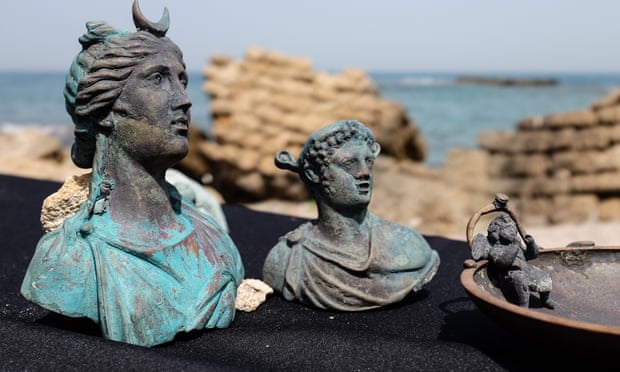
Two amateur divers discovered Israel’s biggest haul of underwater Roman-era artefacts in three decades. The priceless objects were shown for the first time last week.
Figurines of the moon goddess Luna and Dionysus, the god of wine.

The treasures were found in April by Ran Feinstein and Ofer Raanan when they were exploring a sunken ship close to the ancient port of Caesarea.
They initially left the first sculpture on the seabed, but then when they discovered a second, they realised it was something special and brought it to the surface. They later searched the area and uncovered more.
To their credit, they informed the Israel Antiquities Authority (IAA) who sent their divers to investigate further.
Some of the objects date back to the fourth century CE, while others are from the first and second centuries, said Jacob Sharvit, the director of marine archaeology at the IAA.
Sharvit said it was likely that the ship’s sailors had thrown down their anchors in a storm but, after their attempts failed, the ship drifted and all its cargo plunged into the Caesarea port waters, where it remained for 1,700 years until its recent discovery.

Hopefully the finds will be on public display very soon.  A recent treasure trove of 11th century Islamic coins found off the coast of Caesarea are currently displayed in the Israel Museum's archeology department.
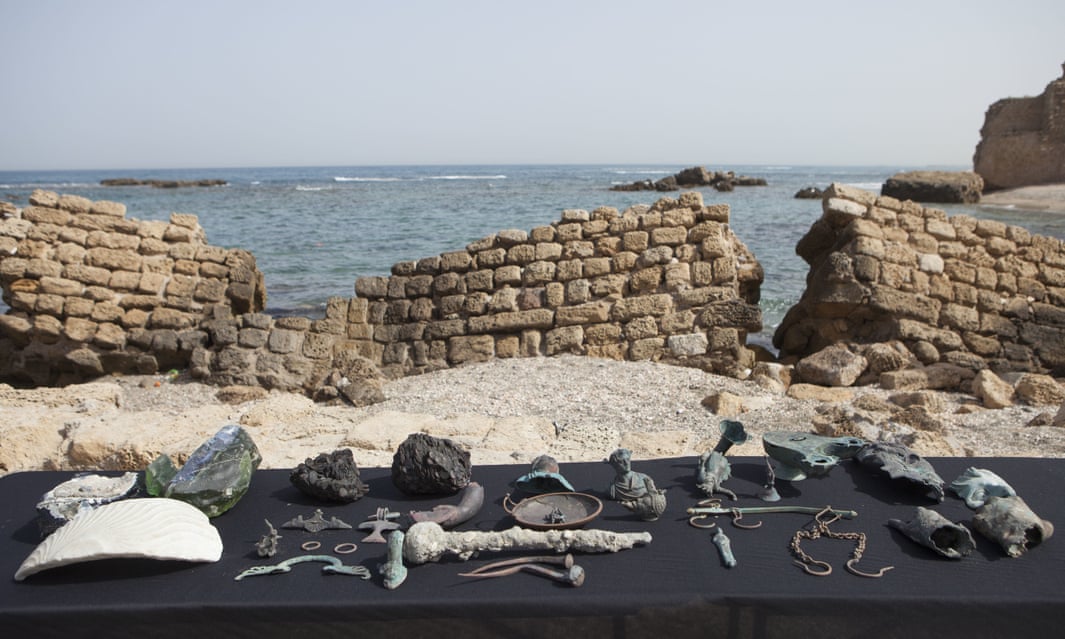
On Display - some of the haul


Friday, May 23, 2014

Methuselah - Ancient Date Tree from Masada - Watch the Film!

Whenever I visit Masada, which I do frequently, I talk about the ancient Judean date pits which were found in the store rooms by the archeologist Yigal Yadin back in the mid-1960's.  More specifically I mention Methuselah, the 2000 year old date pit which is growing on Kibbutz Ketura in the Arava.

For thousands of years, Judean date trees were one of the most recognizable and welcome sights for people living in the Middle East -- widely cultivated throughout the region for their sweet fruit, and for the cool shade they offered from the blazing desert sun.
The Judea Capta Coin minted after the destruction of Judea - the woman sitting under the date palm signified Judea
 
From its founding some 3,000 years ago, to the dawn of the Common Era, the trees became a staple crop in the Kingdom of Judea. Judean palm trees would come to serve as one of the kingdom's chief symbols of good fortune; King David named his daughter, Tamar, after the plant's name in Hebrew.
By the time the Roman Empire sought to usurp control of the kingdom in 70 AD, broad forests of these trees flourished as a staple crop to the Judean economy -- a fact that made them a prime resource for the invading army to destroy. Sadly, around the year 500 AD, the once plentiful fruit trees had been, driven to extinction for the sake of conquest.

In the centuries that followed, first-hand knowledge of the tree slipped from memory to legend. Up until recently, that is.
During excavations at the site of Herod's palace in Israel in the early 1960's, archeologists unearthed a small stockpile of seeds stowed in a clay jar dating back 2,000 years. For the next four decades, the ancient seeds were kept in a drawer at Tel Aviv's Bar-Ilan University. But then, in 2005, botanical researcher Elaine Solowey decided to plan some and see what, if anything, would sprout.
"I assumed the food in the seed would be no good after all that time. How could it be?" She was soon proven to be wrong.

Amazingly, the multi-millennial seed did indeed sprout -- producing a sapling no one had seen in centuries. Today, the living archeological treasure continues to grow and thrive; In 2011, it even produced its first flower -- a heartening sign that the ancient survivor was eager to reproduce. It has been proposed that the tree be cross-bred with closely related palm types, but it would likely take years for it to begin producing any of its famed fruits. Meanwhile, Solowey is working to revive other age-old trees from their long dormancy.


Methusalah, October 2014
 Picture by Jill Rosenfield


Saturday, April 13, 2013

Herod the Great: The Man and His Mausoleum

Was King Herod really such a bad guy or did he have the wrong PR agent? What did he look like? Was he a cruel tyrant or a shrewd politician? What do we really know about him?

King Herod the Great
Herod (Getty Images)
 
Some of these questions can be answered at the world's first exhibit on Herod the Great which opened in February 2013 at the Israel Museum - Herod the Great: The King's Final Journey.

Following the discovery of Herod's tomb in 2007 by the late Professor Ehud Netzer, it was decided to mount an exhibition on his building projects. The exhibition follows Herod's final journey from his winter palace in Jericho to Herodium where he planned his burial place.

The life and legacy of Herod the Great, ruler of Judea from 37-4 BCE and considered among the most important imperial figures in history, is the focus of this groundbreaking exhibition. The exhibit focuses on his projects in Jericho and Herodium and his relationship with Rome. Rare artifacts from the sites are displayed for the first time together with items from the Roman world.
The exhibition also features a monumental, full-size reconstruction of the burial chamber of the king’s mausoleum, including the intricately carved sarcophagus believed to have held his body, together with fragments from the Second Temple of Jerusalem and reconstructed palace chambers decorated with meticulously restored wall paintings and stucco and mosaic work.The scale of the exhibit eclipses the usual painstaking work necessary to produce the average museum show. With some 30 tons of columns, stones and frieze fragments from Herodium, floors had to be reinforced and ceilings raised at the 900-square-meter exhibition space.

Herod the Great Exhibition Jerusalem
 
A tour of the exhibit helps us understand Herod's world and the building styles and techniques that he introduced into the country. Love him or hate him one cannot fail to be impressed by his work.


The exhibit s proving to be extremely popular. During Passover week alone over 35,000 people passed through the exhibit and many more have followed.

STOP PRESS! Due to popular demand the exhibit has been extended until January 4, 2014.
Don't miss it!