Monday, April 20, 2020
Virtual Jerusalem Tour March 2020
Easter and Passover are busy tourist times in Israel. This year is different from all others. The city is empty. Tourists and their guides are at home and sites are closed.
Here you can take a tour through the beautiful but empty streets of the old city.
To paraphrase Rabbi Judah HaLevy, I am in the West but my heart is in the East
I cannot wait to return.
https://www.youtube.com/watch?v=k2WxwZeGH-U
Looking forward to better times.

Thursday, September 26, 2019
Rare color footage from 1930s casts new light on holy city
I am a fan of old black and white photographs of Jerusalem.
 |
| Inside the Jaffa Gate |
The Jerusalem Cinemateque has digitized the rare photographs. The photos and a short film of the old city can be seen in this link: https://www.ynetnews.com/articles/0,7340,L-5569188,00.html
Note that the Holy Sepulchre was undergoing renovations after the earthquake of 1927.
Apologies for the extraneous adverts, but I think this is worth it for a rare journey to Jerusalem past.
Note that the Holy Sepulchre was undergoing renovations after the earthquake of 1927.
Apologies for the extraneous adverts, but I think this is worth it for a rare journey to Jerusalem past.
Saturday, May 18, 2019
The United Nations Headquarters in Jerusalem - Government House
Built in 1933, the former British High Commissioner's headquarters - Government House or Armon HaNatsiv in Hebrew - is an elegant, monumental building. In Christian tradition, the site is known as the Hill of Evil Counsel, linking it to home of Caiaphas the high priest from the time of Jesus. Situated in the south of the Valley of Hinnom, it commands a superb view to the old city, Mount of Olives, Judean Desert and into Jordan.
 |
| Facade - photo Daniela Penkova |
 |
| Main Guard Entrance to the compound |
Having fallen into disrepair, the building recently underwent a $7 million renovation restoring it to its former glory.
 |
| Sunken Garden from the south photo Daniela Penkova |
Two weeks ago I was fortunate enough to be taken on a private tour of the building which reminded me of the YMCA on King David Street and the Rockefeller Museum.
The simple stone interiors are grand but not overwhelming. High windows allow natural light to flood into the rooms. The most impressive room is the ballroom, which connects to the reception room and incorporates a splendid fireplace designed by Armenian ceramic artist David Ohanessian.
 |
| View to the ballroom |
 |
| The fireplace with Armenian ceramics |
 |
| Ceramic detail |
 |
| Facade at Dusk - photo Daniela Penkova |
Thursday, April 4, 2019
A Centenary of Armenian Pottery in Jerusalem - Hagop Karakashian
2019 marks the centenary of Armenian pottery in Jerusalem. In 1919, David Ohannessian and his two assistants, Megherdich Karakashian and Neshan Balian, were brought to Jerusalem by the British from Kutahya in Turkey to repair the 16th century tiles covering the Dome of the Rock. These craftsmen were glad to leave Turkey to escape persecution and settle in Jerusalem to practise the craft of making richly-colored glazed pottery.
Even though they ultimately didn't carry out the repair work on the Dome of the Rock, the British commissioned their decorative tiles to grace a number of significant public buildings erected during the Mandate Period. These include: the Rockefeller Museum, St. John's Eye Hospital on the Hebron Road, St. Andrew's Scottish Church and the American Colony Hotel.
 In 1964 Stepan and Berj Karakashian established the Jerusalem Pottery workshop on the Via Dolorosa where it remained until the end of 2018. Following Stepan's death that year, his son Hagop (third generation) and his wife Tzoghig, moved the workshop and studio to the Greek Patriarch Street close to the Jaffa Gate in the Christian Quarter.

Their work incorporates traditional Armenian bird, animal and flower designs and biblical scenes on tiles, bowls, plates, mugs and vases. They will also make custom-made panels for your new kitchen or bathroom.

Even though they ultimately didn't carry out the repair work on the Dome of the Rock, the British commissioned their decorative tiles to grace a number of significant public buildings erected during the Mandate Period. These include: the Rockefeller Museum, St. John's Eye Hospital on the Hebron Road, St. Andrew's Scottish Church and the American Colony Hotel.

 |
| Interior - New Pottery Workshop |

It is always a pleasure to stop by and admire the beautiful, hand-crafted work still made in the traditional manner by the family.
Jerusalem Pottery is open daily 9:00 - 19:00 except Sunday. 3 Greek Patriarch Street. 02-6261587


Saturday, July 21, 2018
Through His Father's Eye - Elia Photo - Christian Quarter
Learning of the recent passing of Kevork Kahvedjiah, a kind and gentle soul, I wanted to update this post. His son Elie continues the family tradition.
 |
| Kevork surrounded by his father's pictures Photo: Aliza Orent |
Kevork Kahvedjian was raised in the Armenian Quarter of the Old City Armenia and was raised in an orphanage in Nazareth Jerusalem and throughout the Holy Land as captured by his father’s camera since 1924. Recently, the photographs were used to guide the restoration of the historic Hurva Synagogue in the Jewish Quarter, which was destroyed by the Jordanians in 1948..
A visit to Elia Photo on El Khanka Street is a must for anyone visiting Jerusalem. Even more so if you are interested in photography and historical photographs.
A visit to Elia Photo on El Khanka Street is a must for anyone visiting Jerusalem. Even more so if you are interested in photography and historical photographs.
 |
| Kevork Kahvedjian of Blessed Memory |
Sunday, January 28, 2018
Austria in Jerusalem - the Austrian Pilgrims' Hospice
The Austrian Pilgrims' Hospice, strategically placed in the Muslim Quarter at the junction of the Via Dolorosa and El Wad Street (HaGai), is one of my favourite places to visit while touring the old city.
The Austrian Hospice is one of a number of historical buildings erected by European powers towards the end of the 19th century as the 400-year Ottoman rule was coming to a close.
 After the foundation stone was laid on New Year's Eve 1856 the Hospice became one of the city's leading ecclesiastical guesthouses before being taken over by other parties. It served as an orphanage, internment camp, officers' school and military hospital. In 1985, with assistance from Jerusalem Mayor Teddy Kollek, the building was returned to its original function and is currently run by local and Austrian staff and volunteers.
One of its most famous guests was Kaiser Franz Josef who stayed here in 1869 on his way to the opening of the Suez Canal. In addition to being Emperor of Austria, King of Hungary and monarch of other states in the Austro-Hungarian Empire, he also took the title of "King of Jerusalem".
 A mosaic in the charming chapel depicts him pointing the way to the Holy City leading his new Crusade.
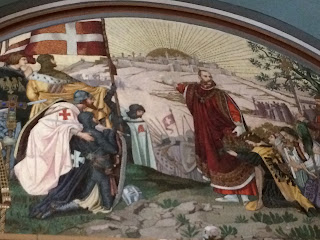
Built in the style of Vienna's Ringstrasse palaces of the 19th century, the pilgrims' hospice is a wonderful place to enjoy a coffee and strudel in the Viennese Cafe or sip a beer in the well-tended gardens.
The Austrian Hospice offers an oasis of tranquility in the old city and affords a wonderful panoramic view from its rooftop. Ring the doorbell to leave the Middle Eastern bazaar and enter the grandeur of the House of Habsburg - a real Jerusalem secret!

 |
| Austrian Hospice in the 19th Century |

One of its most famous guests was Kaiser Franz Josef who stayed here in 1869 on his way to the opening of the Suez Canal. In addition to being Emperor of Austria, King of Hungary and monarch of other states in the Austro-Hungarian Empire, he also took the title of "King of Jerusalem".


Built in the style of Vienna's Ringstrasse palaces of the 19th century, the pilgrims' hospice is a wonderful place to enjoy a coffee and strudel in the Viennese Cafe or sip a beer in the well-tended gardens.
 |
| View from the roof |
There is a fee of 5 shekels to visit the rooftop panorama.
Friday, August 11, 2017
Jerusalem's Hansen Hospital: From Leper Colony to Multi-Media Art School
In the affluent neighbourhood of Talbieh, across the road from the Jerusalem Theatre complex, sits an impressive 19th century building - the former Hansen Hospital. Named after Dr. Gerhard Hansen, the Norwegian physician who discovered the leprosy bacteria in 1873.
In the early 19th century there were no real medical facilities in the Jerusalem. The first modern hospitals were established by Europeans. Leprosy, an infectious disease, was a stigma. It was also misunderstood.
The Hansen House story began with a visit from Germany, of the Baron and Baroness von Keffenbrinck Ascheraden, to the old city of Jerusalem in 1865. During their visit, they encountered lepers living in tents and mud huts at the Zion Gate, an encounter that brought them to decide to promote the establishment of a proper asylum for people with leprosy. In cooperation with a committee of the Joint Anglican-German Protestant Community in Jerusalem, the first leper asylum was established in 1867 next to the old Mamilla Pool. When this initial structure could no longer fit all people with leprosy seeking shelter, it was decided in 1882 that a larger home be built.
Designed by Conrad Schick, a German missionary and self-taught architect, the spacious two-storey building named "Jesus Hilfe" (Jesus Helps) was opened in 1887 with 65 patients. Set among fruit trees and a vegetable garden, it provided clean air, hygiene, nutrition, work, and spritual and emotional support for the patients who were mostly Muslim but there were also Christians and a number of Jews. It was the only place of its kind in the Middle East.
The hospital operated from 1914-1948 with European staff. By 1948 it became part of the Ministry of Health and continued to function until 2000.
The city decided to preserve the building and in 2013 the compound became part of the Bezalel Academy of Arts and Design masters program. The centre includes exhibition spaces, an animation lab, theatre performance space, a projection room, studios for visiting artists, an artists guest house and a restaurant.
I revisited the building last week for the first time since its restoration and enjoyed the delightful Ofa'im Cafe which serves delicious dairy meals in historic surroundings. The small museum is open to the public free of charge.
In the early 19th century there were no real medical facilities in the Jerusalem. The first modern hospitals were established by Europeans. Leprosy, an infectious disease, was a stigma. It was also misunderstood.
The Hansen House story began with a visit from Germany, of the Baron and Baroness von Keffenbrinck Ascheraden, to the old city of Jerusalem in 1865. During their visit, they encountered lepers living in tents and mud huts at the Zion Gate, an encounter that brought them to decide to promote the establishment of a proper asylum for people with leprosy. In cooperation with a committee of the Joint Anglican-German Protestant Community in Jerusalem, the first leper asylum was established in 1867 next to the old Mamilla Pool. When this initial structure could no longer fit all people with leprosy seeking shelter, it was decided in 1882 that a larger home be built.


Designed by Conrad Schick, a German missionary and self-taught architect, the spacious two-storey building named "Jesus Hilfe" (Jesus Helps) was opened in 1887 with 65 patients. Set among fruit trees and a vegetable garden, it provided clean air, hygiene, nutrition, work, and spritual and emotional support for the patients who were mostly Muslim but there were also Christians and a number of Jews. It was the only place of its kind in the Middle East.
The hospital operated from 1914-1948 with European staff. By 1948 it became part of the Ministry of Health and continued to function until 2000.
 |
| Main Entrance and Gardens |
 |
| Hansen Hospital Museum |
Two rooms are dedicated to the history of the hospital and Hansen's Disease.
The city decided to preserve the building and in 2013 the compound became part of the Bezalel Academy of Arts and Design masters program. The centre includes exhibition spaces, an animation lab, theatre performance space, a projection room, studios for visiting artists, an artists guest house and a restaurant.
I revisited the building last week for the first time since its restoration and enjoyed the delightful Ofa'im Cafe which serves delicious dairy meals in historic surroundings. The small museum is open to the public free of charge.
n
Subscribe to:
Posts (Atom)